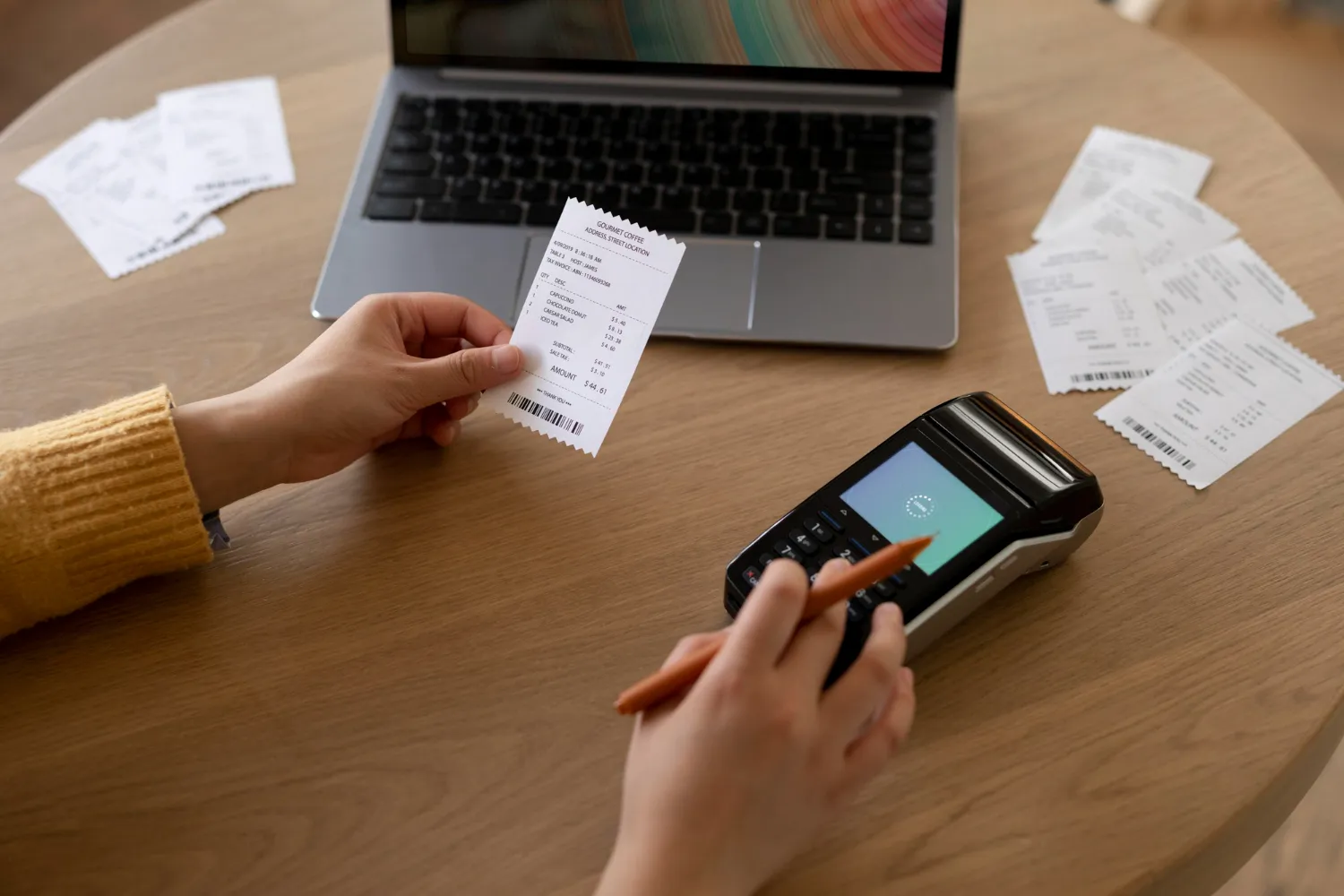
At the moment of the sale, a lot of stores still do the same thing: print the receipt, hand it over, and move on to the next customer. It feels like enough. The problem shows up later, when the customer loses the receipt, asks for it again on WhatsApp, wants to confirm the amount, or needs to show the purchase to someone else.
That is when the comparison between digital and printed receipts becomes obvious.
Customers usually choose the format that creates the least friction. If the purchase happened through WhatsApp, was paid by transfer or payment link, and could still raise questions later, a digital receipt usually works better. If the purchase happened in a physical store with immediate pickup, a printed receipt still does its job well.
The point is not to say paper is obsolete. The point is to understand when it helps and when it only creates extra work.
That difference matters more now because the way people pay has changed. Digital payments and phone-based transfers have become part of everyday shopping in the U.S., including for smaller purchases. When payment already happens on a phone, purchase confirmation tends to follow the same path.
If you sell at the counter, through WhatsApp, or both, the right question is this: when does the customer actually want paper, and when do they just want a receipt that is easy to find later?
Customers want convenience, not bureaucracy
For the store, a receipt often looks like a small administrative detail. For the customer, it serves a much simpler purpose: making it clear what was agreed.
They want to look at it and understand:
- what they bought
- how much they paid
- how they paid
- whether anything is still pending
- how to find it later
When the receipt does that job, it creates confidence. When it does not, it becomes just another lost piece of paper or another file with no context.
This matters a lot in conversation-based sales. On WhatsApp, for example, negotiation can be fast, but the sales record often gets messy. The customer asks for the amount again, you scroll through old messages, and the team cannot remember whether the order was confirmed or whether it was only purchase intent.
In practice, customers are not asking for "digital transformation." They are asking for:
- not having to rely on memory
- not having to rely on loose screenshots
- not having to ask for the same receipt twice
- not having to hear "let me see if I can find it"
That is why, in many scenarios, digital receipts start to win ground.

What really changes between digital and printed receipts
The first difference is not visual. It is operational.
A printed receipt works well when the purchase needs to end right there, in the same minute, with something physical in the customer's hand. That fits a counter-based store, immediate pickup, a line-based operation, or any type of service where paper still signals closure.
A digital receipt works better when the sale doesn't end with the payment.
It lets you:
- send it by WhatsApp or another channel
- resend it without rebuilding the sale
- connect proof of purchase to the right customer
- keep an order history
- record the agreement, timeline, and notes
That difference changes the whole routine.
When the receipt exists only on paper, the store depends more on the in-person moment. When it also exists digitally, the sale leaves a trail.
That is why so many businesses have started working with digital receipts without turning them into one more bureaucratic step.
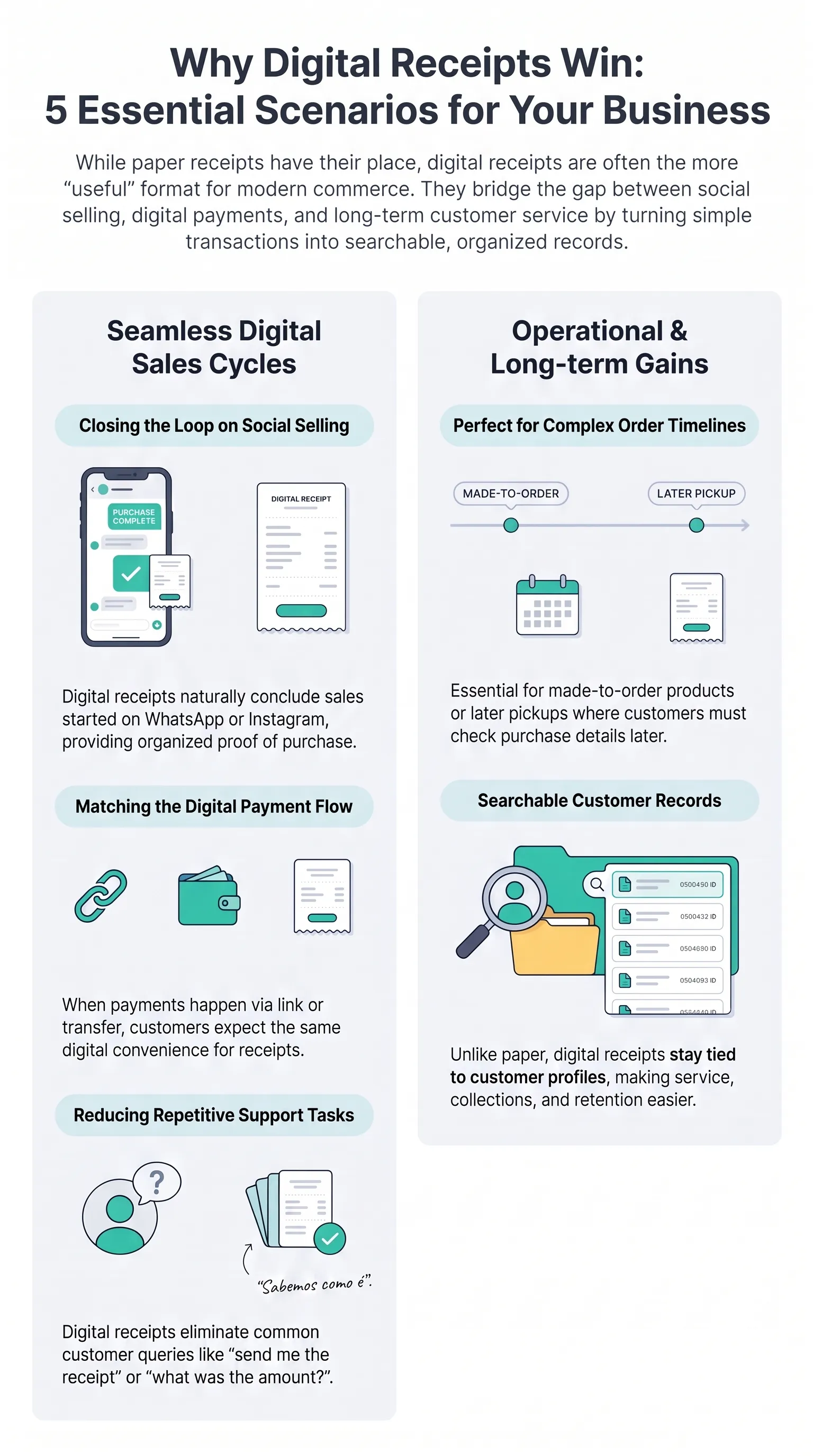
When digital receipts usually win
There are situations where a digital receipt is more than just a more polished option. It is the more useful format.
1. When the sale happens through WhatsApp or Instagram
If the order started in a conversation, was adjusted in chat, and ended in a transfer or payment link, it does not make much sense to close all of that with a piece of paper. The customer is not even there to receive it.
In those cases, a digital receipt completes the process naturally. It turns a loose series of messages into an organized proof of purchase. The customer receives it in the same channel they used to buy. The store keeps the history without having to dig through old conversations.
2. When payment happened digitally
If the money already came in through a transfer or payment link, the expectation of convenience is already there. The customer completed payment on a phone, so receiving a digital receipt afterward makes more sense than relying only on printing.
Not because paper became useless, but because the whole flow is already digital.
For many stores, that cuts out a large number of small support requests:
- "send me the receipt"
- "what was the final amount again?"
- "can you resend it?"
- "I need to show it to someone at home"
3. When the customer may need to check the purchase again
Made-to-order products, later pickup, changes to delivery dates, professionally managed pay-later sales, personalized orders. All of that increases the chance that the customer will need to look at the order again.
In those cases, a printed receipt only solves the present moment. A digital one solves the present and what comes after.
4. When you need to connect receipt, order, and customer
This is where the gain matters most operationally.
A paper receipt handed over at checkout can disappear in a few hours. A digital receipt tied to the order and to the customer record stays searchable. That helps with customer service, resending, collections, and even retention.
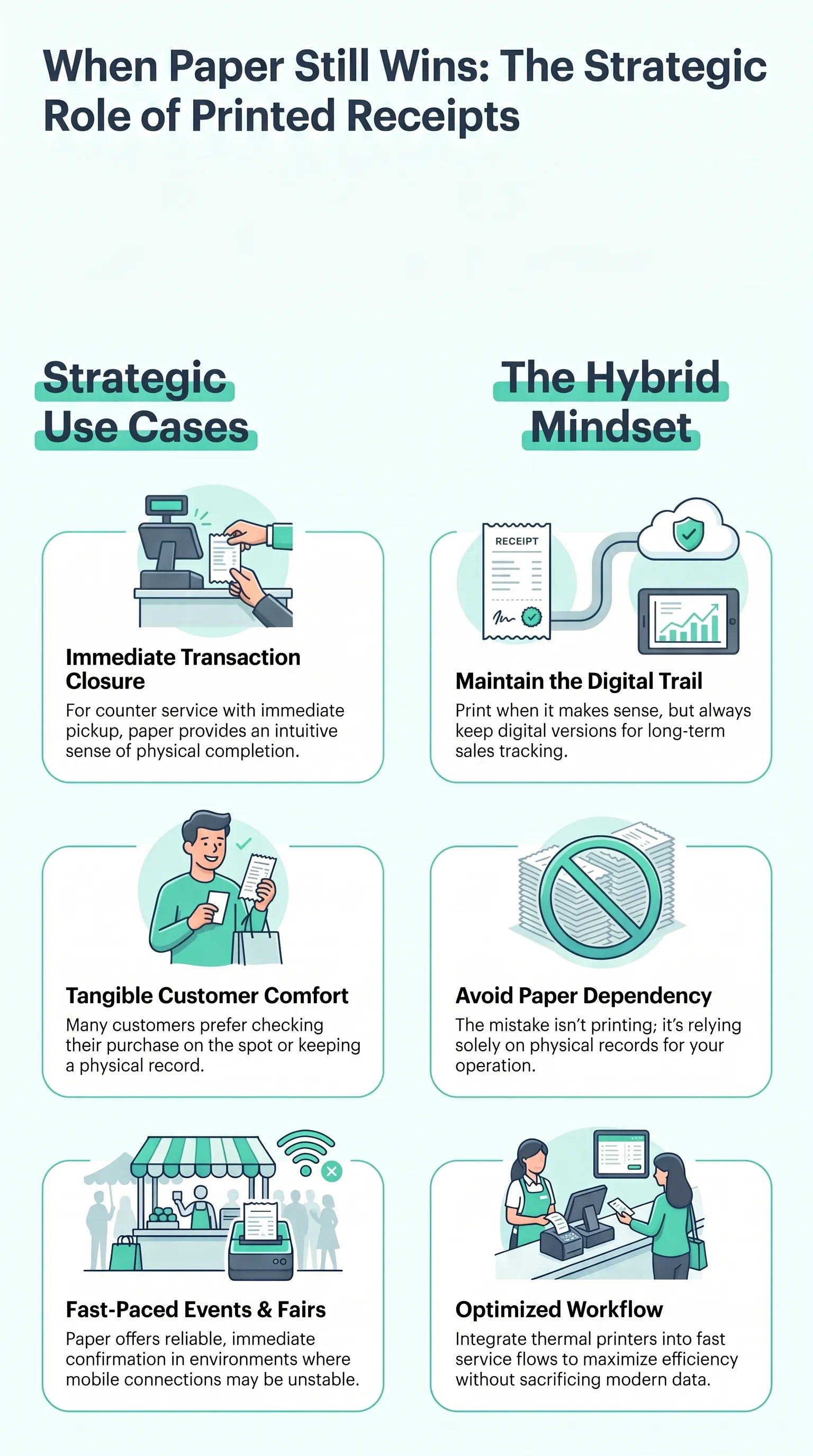
When printed receipts still make sense
It would be too simplistic to say printed receipts have lost their role. They have not.
They still fit well in some settings.
1. Counter service with immediate pickup
When the purchase starts and ends there, with the customer walking out at that moment, a printed receipt still plays an intuitive role. It closes the transaction quickly and gives a physical sense of completion.
2. Customers who like leaving with something in hand
Depending on the audience, paper still creates a certain sense of comfort. You see this a lot in in-person service, especially when customers want to check the purchase on the spot or keep something physical in a wallet or bag.
3. Operations already built around a thermal printer
If your store already runs with a thermal printer, a counter, and fast service, a printed receipt can still be an efficient part of the flow.
But that does not mean the store has to depend only on it.
A mature operation can print when it makes sense and still keep the digital version as a record of the sale.
4. Fairs, events, or fast in-person sales
In faster environments, paper can still work as an immediate confirmation, especially when the connection is unstable or when the customer does not want to stop and receive something on their phone right then.
The mistake is not printing. The mistake is depending only on that.
What your store loses when it depends only on paper
Many people see a printed receipt as a neutral option, almost cost-free. But it carries a quiet operational cost.
When a store depends only on paper, this is what usually happens:
- the customer loses the proof of purchase
- the team has to resend information manually
- the order gets disconnected from its history
- the purchase confirmation comes back into the chat as a question
- the team has to piece the conversation back together
That rework rarely shows up in a report, but it weighs on the routine. It weighs on time, patience, and perceived professionalism.
One of the biggest gains of a digital receipt is moving the close of the sale out of the memory game. Instead of depending on "I think this was it," the store gets a record that is easy to find.
Digital receipts improve the perception of professionalism
This point is often underestimated.
Many stores think professionalism lives in the receipt design. Design helps, but what really communicates professionalism is clarity in the process.
When you generate a digital receipt, send it through the right channel, and keep everything recorded, you communicate a few things without having to explain them:
- "the order is confirmed"
- "I know exactly what was agreed"
- "if you need it later, I can send it again"
- "I'm not improvising"
That changes the customer experience.
Once the order is registered, the store can say something like, "I can hold this reservation for 2 hours while payment comes through." It does not sound like a threat. It sounds like a well-defined process.
The same goes for sales records, balance follow-ups, and payment confirmation.
In all those cases, the receipt stops being a nice-looking piece of paper and becomes part of the service.
How to decide without making life harder for the customer
If you want to choose between digital and printed receipts, the safest path is this:
Use digital receipts as the operational default
Because they simplify recordkeeping, receipt resends, and customer follow-up.
Keep printed receipts as a smart exception
Because there are still in-person situations where customers want to leave with something physical.
Do not force customers to change their behavior
They do not need to download an app, create an account, or learn something new. The best digital receipt is the one that arrives through a channel they already use, like WhatsApp or email.
Think about what happens after the sale, not just at the end of it
That is what separates an organized store from an improvised one.
Did the sale end for you?
Or is it still going to come back as:
- a request for proof of purchase
- a question about the amount
- a pickup question
- another purchase from the same customer
If the answer is yes, digital tends to win.

So what do your customers prefer?
The most honest answer is: it depends on the context of the purchase. But when the question includes convenience, resending, and continuity, digital receipts tend to be the preferred option.
Printed receipts still work well in specific cases:
- in-person purchases
- immediate pickup
- counter-based operations
- customers who want to leave with something physical in hand
Digital receipts win when the sale needs to remain accessible:
- WhatsApp purchases
- digitally completed payments
- delivery orders
- repeat customers
- a need to resend
- operations that depend on history
In short, digital receipts should become the operational standard, while printed receipts can remain a support tool when they make sense for the customer.
That combination serves both sides better. Customers get convenience, and the store gets clarity.
Where Kyte fits into this flow
In Kyte's online receipt flow, the proof of purchase stops being a disconnected step and becomes part of the order itself. That helps organize the sale, keep history, and resend the receipt when the customer needs it.
If your operation mixes counter service, WhatsApp, digital payments, and repeat customer service, this kind of flow matters because it connects:
- the order
- the customer
- the amount
- the payment method
- the receipt
And when needed, the store can still print the proof of purchase by connecting Kyte to a Bluetooth thermal printer.
If today you are still handling too many sale confirmations through loose text, screenshots, and memory, it is worth seeing how sales control, customer records, and WhatsApp sales connect inside Kyte. That is where the receipt stops being bureaucracy and starts becoming part of a much tighter operation.
Frequently Asked Questions
Does a digital receipt count as proof of purchase for the customer?
Yes. For the customer, a digital receipt works as the commercial record of the purchase. It shows what was bought, how much was paid, and what was agreed in the sale.
Can I send a receipt through WhatsApp?
Yes. In many small businesses, sending a receipt through WhatsApp is the most natural path, because the sale either happened there or was coordinated there.
When is it still worth printing a receipt?
Mainly in counter service, immediate pickup, faster in-person operations, and cases where the customer prefers leaving with something physical in hand.
Does a digital receipt replace a payment confirmation?
Not exactly. A digital receipt records the sale and the commercial agreement. A bank payment confirmation verifies the financial transaction. The two can coexist.
How do you create an online receipt without complicating the operation?
The simplest way is to use a system that generates the online receipt from the order itself. That way, you avoid loose text, reduce rework, and can resend the proof of purchase whenever needed.